


Advancing open research information: The next three years of the Information & Openness focal area
Today we published the 2026-2028 strategic plan for the Information & Openness focal area. This blogpost provides an overview of the plan, describing our vision and objectives for advancing the uptake of open research information in the coming years.
The need for open research information
Research information — which describes research outputs, activities, and actors — is essential to understand how science operates, how knowledge is produced, and how research systems evolve. Despite its importance, much of this information remains locked in closed and proprietary systems, creating barriers to its use. These barriers restrict the possibility to study the research system in a comprehensive way, to make well-informed decisions about its governance, and to ensure equity in information access and decision-making.
The Information & Openness focal area at CWTS was founded in 2023 to address these challenges by working to advance the creation and use of open research information (ORI) that is free to access and reuse without restriction. In this blogpost, we outline a strategic plan, developed to guide our work toward this goal over the next three years.
The need for strategic action at CWTS
We have already made significant progress within the focal area. We have taken a leading role in developing the Barcelona Declaration on Open Research Information, developed and delivered the course Scientometrics Using Open Data multiple times, used ORI in a variety of projects, contributed to studying and improving the coverage and quality of ORI in open data sources, and pioneered the use of ORI in university rankings through the Leiden Ranking Open Edition. In order to continue this work in a coordinated fashion, we saw a need to develop a strategic plan for our focal area to help guide our efforts. This plan will serve as a framework to guide our activities, to inform decisions about which new projects and collaborations to pursue, and to assess our progress.
Developing the strategic plan: A co-creation process
The strategic plan was developed over a ten-month period in 2025, in which the members of the focal area collaboratively brainstormed where we would like to go and what we would like to achieve in the coming years. The focal area coordinators summarized the group’s input and presented versions of the strategic plan to the focal area members for iterative development. The plan was then further discussed with the other focal area coordinators from Engagement & Inclusion and Evaluation & Culture, and the CWTS Board. Individual conversations were then held with each focal area member in order to discuss how their work and interests align with the plan and to get further feedback.
The strategic plan consists of an overarching vision outlining our long-term ambition, three high-level strategic objectives describing the ideal effects we aim to achieve in the broader research system, and nine operational objectives translating our strategic objectives into actionable steps. We briefly summarize each of these here. More detail can be found in the full version of the plan.
Our vision
The vision of the Information & Openness focal area is:
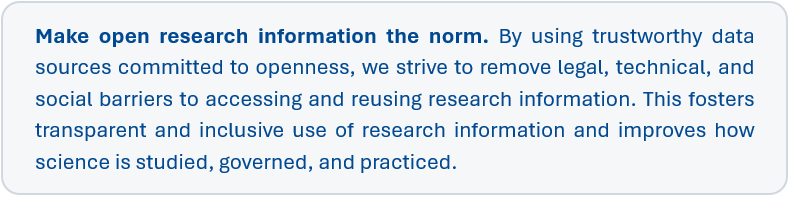
This vision highlights how ORI can transform the barriers presented by proprietary research information. ORI not only helps make research assessment more transparent and responsible, but it also contributes to developing a more inclusive understanding of what is happening in the research system. By removing barriers and promoting openness, we enable diverse stakeholders such as researchers, institutions, policymakers, and society at large to engage with science in a more democratic and equitable way.
This vision is therefore not isolated but is deeply connected to the broader mission of CWTS and to the other two focal areas. Together, these three focal areas strengthen CWTS’s commitment to improving how science is practiced and governed and how it serves society.
Strategic objectives
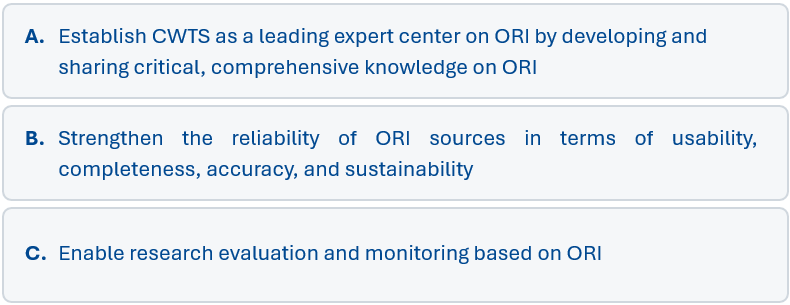
The above vision provides the foundation for our strategic objectives, which define the ideal effects we aim to achieve and indicate what the focal area will contribute to in the broader research system. Our three strategic objectives are to:
Operational objectives
Our operational objectives translate these strategic ambitions into concrete, actionable steps. They provide clarity on what needs to be done, ensuring that our vision and strategic goals are not only aspirational but also implementable.
Each operational objective is directly linked to one or more strategic objectives:
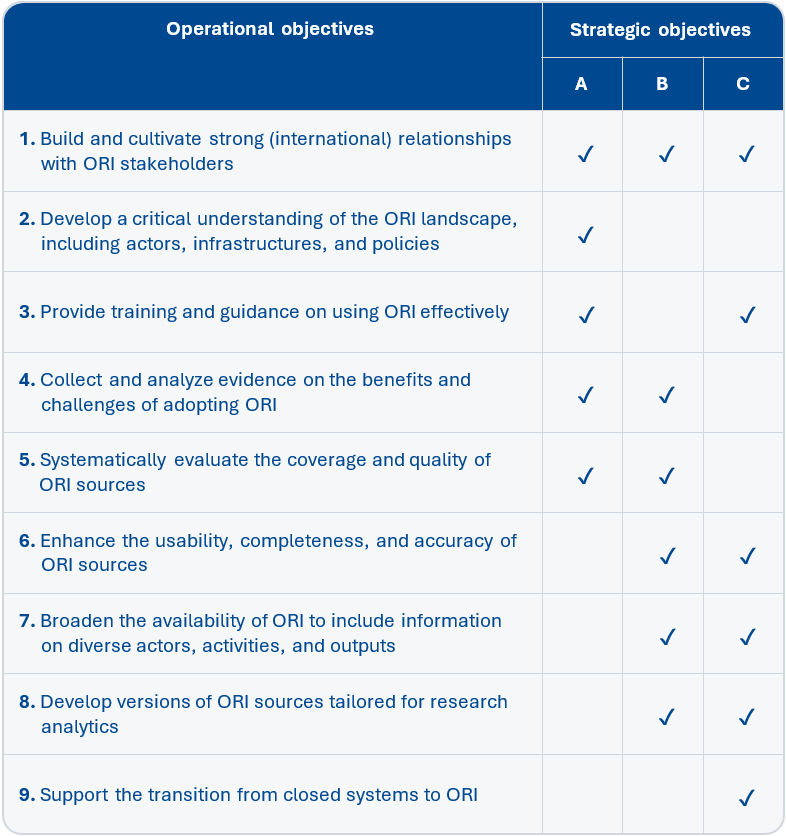
More detail about each operational objective, including examples of (planned) projects, services, and courses to achieve these objectives, can be found in the full strategic plan. The objectives are often complementary and interconnected. We also anticipate that there will be some flexibility in the operational objectives and planned results as we put them into practice.
Next steps and collaboration
We plan to re-evaluate the strategic plan annually in order to make necessary modifications to these objectives as the ORI landscape continues to evolve and to ensure continued alignment with our other focal areas. Together, these objectives will help to guide our work in achieving the primary ambition of the Information & Openness focal area: to make open research information the norm, rather than the exception. If you would like to collaborate with us to work towards this vision, please read the strategic plan in more detail and reach out to the coordinators of the focal area. We are looking forward to achieving our vision together.
Header picture by Zizi_zi on Unsplash.
DOI: 10.59350/7zn3s-3n060 (export/download/cite this blog post)
0 Comments
Add a comment