

The mosaic of science: When does disciplinary diversity translate into prestige?

Scientific collaboration across disciplines resembles a mosaic, with each piece contributing to a composition more coherent than any fragment on its own. This diversity is widely seen as necessary for tackling complex problems. But does it also translate into scientific prestige?
National science systems around the globe are being urged to become more interdisciplinary and collaborative. Research groups are the natural unit in which these factors converge. Policymakers promote cross-disciplinary research groups as engines of innovation and funding agencies increasingly privilege integrative proposals. But how does team diversity relate to team performance, understood as the capacity to generate high-impact research or innovative intellectual property? Evidence from organisational studies suggests that the relationship between cognitive diversity and team output is statistically significant and positive, but modest in magnitude and contingent on the complexity of the tasks the team undertakes. However, what can we say regarding research groups more specifically?
Scientific prestige is typically measured through citation-based metrics that reflect the reach and impact of academic outputs such as research articles. Whether disciplinary diversity translates into such prestige is a question with direct practical stakes for researchers, science policymakers designing incentive structures, and university leaders allocating scarce resources. These stakes are particularly meaningful in middle- and low-income countries, where funding constraints and policy shifts make decisions about the composition of research teams especially strategic.
In Colombia, the national assessment of research groups adopts a broad conception of scientific prestige that encompasses human capital formation, knowledge dissemination, technological transfer, and the accumulated experience of research members, with the assigned rank carrying tangible consequences for institutional visibility, accreditation, and competitiveness in national funding calls.
A glimpse into the national assessment of research groups in Colombia
In a recent nationwide study of 3,575 formally recognized research groups in Colombia, I examined this assumption using ten years of open-access data from the Ministry of Science, Technology, and Innovation (MinCiencias) of Colombia. The results suggest that diversity matters, but not in a linear way and across all disciplinary areas alike.
Colombia’s national research group assessment offers a system-wide window into the research group: the basic unit for knowledge production and technological development. A research group, in the Colombian context, is not inferred from co-authorships. It is a formally registered, stable unit affiliated with an academic unit such as a school or department, with a defined roster of members, a research direction, and a designated leader.
Knowledge produced collectively is attributed to the group as an entity, which makes it a sharper unit of analysis than a transient co-author team. Every two to three years, MinCiencias runs a national call that classifies groups into five ranks: A1, A, B, C, and Reconocido. The last category, which translates roughly as 'recognized', designates groups that meet the minimum criteria to be formally acknowledged as a research group within a given call, without yet attaining a ranked position. The classification rests on a broad conception of scientific prestige discussed above, that goes beyond citation-based metrics to encompass human capital formation, knowledge dissemination, technological transfer, innovation activities, and the accumulated experience of research members. This composite assessment is applied consistently across all disciplinary areas, and the rank it produces carries inputs for institutional visibility, academic accreditation, and competitiveness in national funding calls. In this study, rank serves as the operational measure of scientific prestige.
Measuring disciplinary diversity
To quantify disciplinary diversity in research groups from Colombia, I employed the DIV indicator, a composite measure integrating three dimensions:
- Variety: the number of distinct disciplines represented within a group.
- Balance: the evenness of researcher distribution across those disciplines.
- Disparity: the cognitive distance between the disciplines involved.
For instance, a research group composed of epidemiologists, electrical engineers, sociologists, and a visual artist exhibits both variety and disparity. In contrast, a group composed entirely of clinical psychologists, even if many, displays low variety and low disparity.
Diversity is therefore not just about counting disciplines. It is about how they are distributed and how far apart they are conceptually.
Prestige and diversity: a non-monotonic relationship
The central question of this research was whether higher diversity tracks higher scientific prestige. The answer is nuanced.
Figure 1 displays the median DIV of 3,107 research groups across six areas (i.e., Medical and Health Sciences, Natural Sciences, Engineering and Technology, Social Sciences, Humanities, and Agricultural Sciences) for 2021 as most recent national assessment for which open access data was available at the moment the study was conducted.
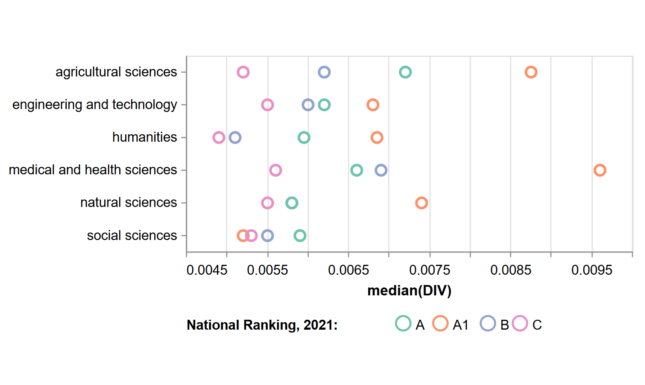
Results show that:
- The median DIV varies across major disciplinary areas.
- Across most of them, there is a positive association between DIV and national ranking, with groups ranked A1 and A recording the highest median DIV, particularly in agricultural sciences, engineering and technology, and humanities.
- This gradient is most pronounced in medical and health sciences and agricultural sciences, which not only exhibit the steepest rank-diversity differentials but also record the highest absolute diversity values at the A1 level among all areas. This suggests that in disciplines with stronger international collaboration traditions and applied research orientations, diversity and prestige tend to be more tightly coupled.
- Partial exceptions are found in medical and health sciences and natural sciences, where B-ranked groups scored higher or similar median DIV than A-ranked groups, disrupting the otherwise consistent gradient.
- The clearest exception, however, is social sciences, where B and C-ranked groups recorded higher median DIV than A1 groups, which were in fact those with the lowest diversity values in the area. This inversion suggests that in social sciences, the highest-ranked groups may operate within more disciplinarily concentrated and locally or nationally bounded research networks.
These findings align with broader evidence suggesting that diversity explains only a small fraction of performance variance. Diversity is not a universal performance enhancer. It operates within structural and institutional constraints.
What should policymakers learn?
In essence, my findings suggest three implications:
- 'More diversity is better' is too blunt a policy rule, because the relationship between diversity and prestige is non-linear and field dependent. Yet, policies might change and scientific prestige is not the only purpose of collective endeavours of research groups.
- Policymakers could strengthen the link between diversity-sensitive aspects in funding criteria, given the consistent positive association between DIV and national rank. This could be operationalized by incorporating explicit diversity indicators into the assessment rubrics of funding calls, moving toward measures of collaboration among disciplinary areas, considering the disciplinary caveats.
- The exceptions observed in social sciences warrant targeted policy attention. The inverse relationship between rank and diversity in this area suggests that current assessment criteria may be rewarding research models that are disciplinarily concentrated and nationally bounded. Incentives for international and interdisciplinary collaboration in social sciences may need to be designed differently than those applied to natural or applied sciences, where such collaboration is already embedded in disciplinary practice. Clearly, if the goal is to increase scientific prestige via disciplinary diversity.
A mosaic, not a formula
Scientific systems resemble mosaics rather than linear pipelines. Disciplinary diversity is one of the tiles, but its contribution depends on how it interacts with others (e.g., funding, evaluation criteria, and disciplinary culture, team size, and other variables to be considered more systematically in further studies).
In Colombia’s case, disciplinary diversity seems to be a contextual variable embedded in institutional structures.
The data used here are Colombian, but the structural pressures they reveal, funding scarcity, incremental research agendas, and metric-based national evaluations, are documented across other Latin American science systems, which makes the lessons transferable even if the evidence base is national. As countries continue to push interdisciplinarity in science policy, the challenge is not to maximize diversity, but to understand when, where, and under what conditions it translates into sustained scientific prestige by leveraging disciplinary diversity as either a national or institutional policy strategy.
Header image by Andrey K on Unsplash.
DOI: 10.59350/45mpw-pa230 (export/download/cite this blog post)



0 Comments
Add a comment