
The CWTS Leiden Ranking 2026: final release of the Traditional Edition


Today, CWTS published the final release of the Traditional Edition of the CWTS Leiden Ranking. This post reflects on this special occasion. It also discusses the implications of ongoing developments in the scholarly communication system for the future of the Leiden Ranking.
Final release of the Leiden Ranking Traditional Edition
In 2024, CWTS published the first release of the Open Edition of the Leiden Ranking, based on data from the OpenAlex database. Over the past couple of years, the Open Edition has co-existed with the Traditional Edition of the ranking, based on Web of Science data. Today, CWTS published the Open Edition and the Traditional Edition of the Leiden Ranking 2026. As announced earlier this year, this is the final release of the Traditional Edition of the ranking. From 2027 onward, the Traditional Edition will be discontinued, and only the Open Edition will remain.
The discontinuation of the Traditional Edition of the Leiden Ranking is a next step in the open research information transition of CWTS and in realising our broader ambition to make open research information the norm. It aligns with broader developments in the Dutch, European, and global research landscape. A growing number of research organisations worldwide have signed the Barcelona Declaration on Open Research Information. These organisations are working hard to advance open research information. In the Netherlands, universities and the national research funder have for instance discontinued Web of Science and/or Scopus subscriptions (see the announcements of Maastricht University, TU Delft, University of Groningen, University of Twente, Utrecht University, Vrije Universiteit Amsterdam, and the Dutch Research Council). Adoption of open research information is growing in other countries as well. In China, for instance, the China Fundamental Research Report was published a few weeks ago. The bibliometric analyses in this high-profile science policy report are based largely on open research information, in particular the OpenAlex database.
In light of the strong support for open research information, at CWTS we are confident that openness of research information will be the norm for future bibliometric analyses. We therefore consider this the right moment to discontinue the use of proprietary data sources in the Leiden Ranking. With the Leiden Ranking 2026, an almost two-decade history of the use of Web of Science data in the Leiden Ranking (see Figure 1) comes to a close.
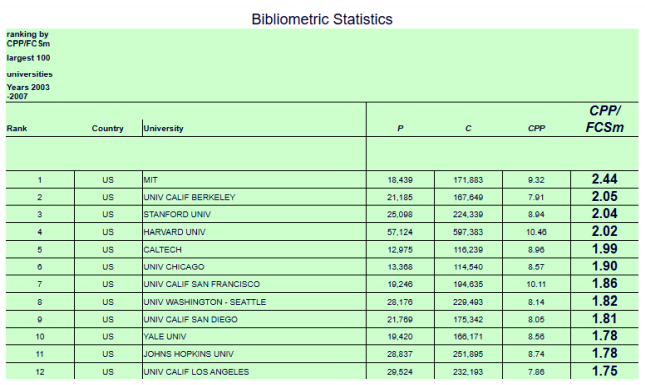
Figure 1: Screenshot of one of the first editions of the CWTS Leiden Ranking, based on Web of Science data. The ranking can be accessed using Internet Archive’s Wayback Machine.
The evolving scholarly communication system
Like earlier editions of the ranking, the CWTS Leiden Ranking 2026 is based on peer-reviewed publications in scientific journals and other scientific publication channels. However, there are several ongoing developments that raise fundamental questions about peer review, and quality assurance more broadly, in the scholarly communication system:
- Weak quality assurance processes. Many journals claim to perform rigorous peer review, but the actual rigor of the peer review performed by journals is often unclear. Some journals perform only superficial forms of peer review, leading to the publication of articles that are of questionable quality. There are even journals, sometimes referred to as predatory journals, that claim to perform peer review while they actually do not perform any quality checks at all. Weak quality assurance processes provide room for paper mills, that is, fraudulent articles published in the scholarly literature. Paper mills are an increasingly important problem, as demonstrated for instance by mass retractions of hundreds or even thousands of publications from the literature. Paper mills may also cause major distortions in citation statistics and may affect university ranking systems.
- Role of AI. AI developments enable researchers to produce increasingly large numbers of publications, often publications that provide little or no new scientific insights, or even publications that are misleading or fraudulent. This development puts additional pressure on the quality assurance processes of journals and therefore exacerbates the problems mentioned above. In addition, peer review is increasingly supported by AI, or even performed entirely by AI, raising further questions about quality assurance practices in the scholarly communication system.
- New approaches to quality assurance. On top of the above developments, there is a growing interest in new approaches to quality assurance in the scholarly communication system. For instance, publish-review-curate approaches offer an increasingly popular alternative to conventional journal peer review processes. There is also a growing recognition that important scientific work can be disseminated through publications that do not necessarily need to undergo peer review (e.g., articles published on preprint servers). At the same time, new quality assurance mechanisms are being introduced, such as a broad range of research integrity checks that many journals nowadays perform. Trust markers are also increasingly being discussed as a mechanism to keep track of the quality checks that a publication has undergone.
The above developments have important implications for the Leiden Ranking. Apart from excluding retracted publications, the Leiden Ranking has no mechanisms to exclude predatory journals and paper mill publications. These journals and publications therefore have an influence on the publication and citation statistics provided in the Leiden Ranking, although currently it is difficult to estimate how big their influence is.
Addressing the above developments will be an important priority for future releases of the Leiden Ranking. CWTS is actively participating in initiatives to develop and implement new approaches to quality assurance in scholarly communication. While it is hard to predict how the scholarly communication system will develop in the coming years, we do expect to see the emergence of innovative new quality assurance mechanisms. As soon as these mechanisms reach a sufficient level of adoption and maturity, incorporating them in the Leiden Ranking will be a key priority for us.
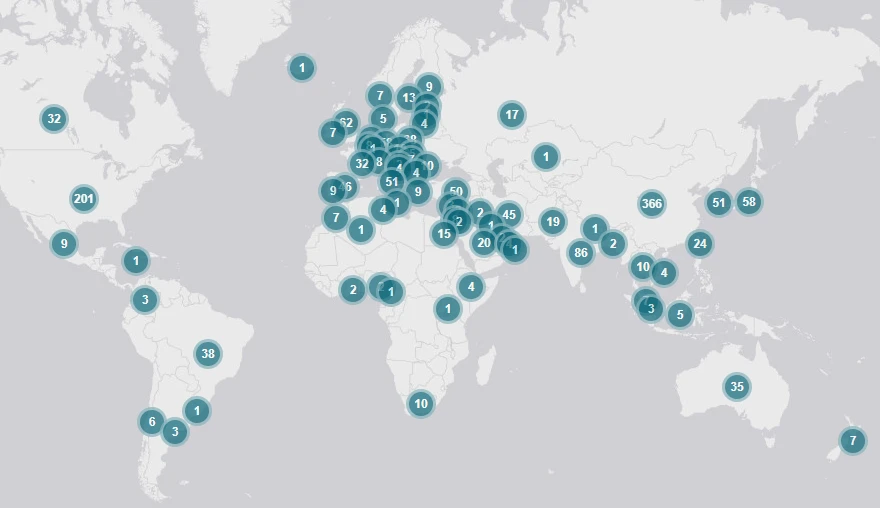
Header image: screenshot of the map view of the CWTS Leiden Ranking Traditional Edition 2026. DOI: 10.59350/escq0-2wx76





0 Comments
Add a comment