

Launch of a new tool to track CoARA signatories

How global is research assessment reform? Our author introduces a practical, interactive dashboard she developed, allowing users to easily view up-to-date information on CoARA signatories worldwide, their distribution, organisation types, and submitted or pending action plans.
The Coalition for Advancing Research Assessment (CoARA) celebrated its 3rd anniversary in December 2025. Since the launch of the Agreement on Reforming Research Assessment (ARRA) in July 2022, over 800 organisations worldwide have signed the agreement, committing to enact changes in how they assess research and researchers. This makes CoARA arguably the foremost initiative that is seeking to inspire and coordinate change in this important area. But who are these signatories, where are they from, and what can their geographical distribution tell us about the global uptake of research assessment reform? While the official CoARA website provides publicly available information on signatories and their action plans, I have developed a user-friendly, practical and interactive dashboard that allows a wide audience to easily explore up-to-date information at a glance.
The idea for a dashboard first came to me while working on my master’s thesis in early 2024. At the time, I was manually updating an Excel file every two weeks just to keep track of developments (and it was time-consuming!). As I continued working on responsible research assessment reform for my PhD research, I thought a dashboard that could be updated automatically would make the monitoring process much easier and more useful - not just for me, but for anyone interested in the topic. That’s how I volunteered to develop a dashboard using data from the official CoARA website. Through web data scraping, the dashboard automatically updates information on signatories by country and organisation type, while also tracking ‘submitted’ and ‘pending’ action plans within the one-year deadline given to signatories - all based on CoARA’s official website.
The dashboard offers a range of useful features:
Overview of signatories
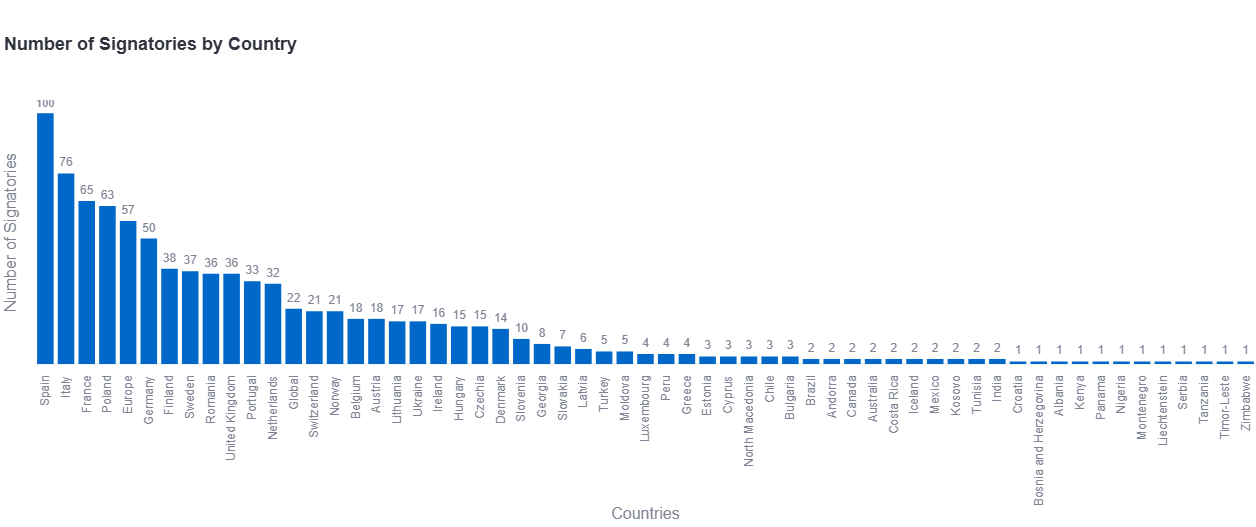
Users can explore the number of signatories by country, including ‘Global’ and ‘European’ associations as defined by CoARA.
Comparison tools
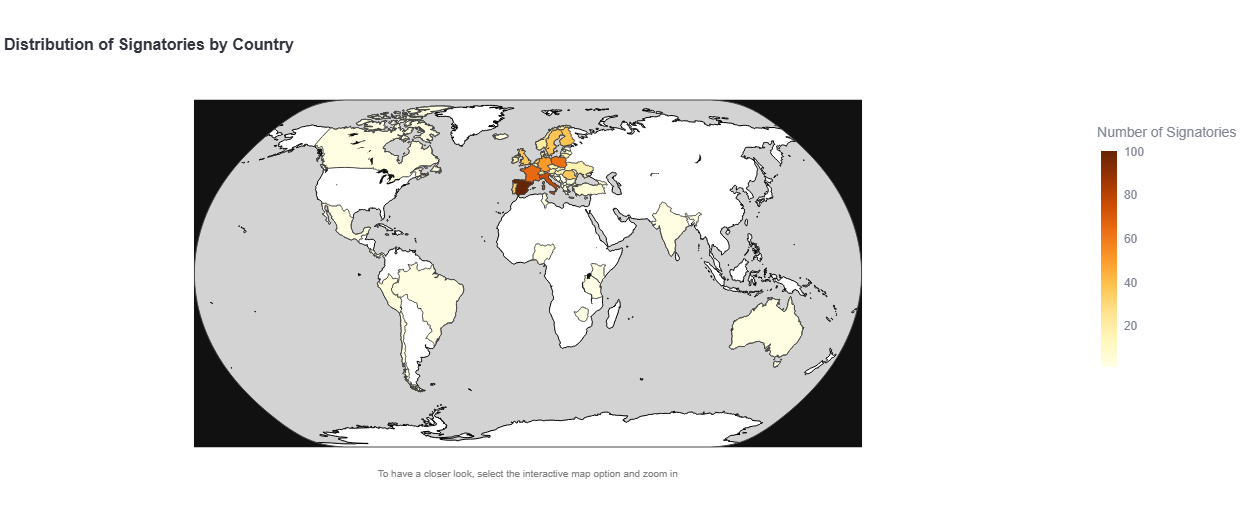
Bar charts allow comparisons of signatories across countries, along with both static and interactive maps of signatories.
Signatories by country
Users can further explore information on signatories from each country using the ‘List of the Signatories per Country’.
Signatories by organisation types
The dashboard also provides an overview of the types of organisations that have signed the agreement, following CoARA’s classification:
- Academies, learned societies, and their associations;
- National/regional authorities or agencies involved in research assessment;
- Public or private research funding organisations and their associations;
- Research centers, research infrastructures, and their associations;
- Universities and their associations;
- Other relevant non-profit organisations involved with research assessment.

Action plan submissions
Users can also track submitted and pending action plans within the one-year deadline given to signatories. [1]

The dashboard also allows users to download open datasets in CSV format for further analysis through the ‘Data Source-About the Data’ section. For the most up-to-date information, users can update the dashboard at any time by clicking the ‘Scrape Data’ button in the ‘Data Source -Update’ section before downloading the datasets.
Last but not least, I continue working to improve the dashboard and make it even more useful for analysis. I also want to emphasize that the dashboard provides an overview of signatories, and for deeper analysis more research and additional data sources are required. When interpreting the data, factors such as the size of each country and its research system should be taken into account; therefore, comparing the proportion of signatories relative to non-signatories is often more informative than looking at absolute numbers.
Take the Netherlands as an example: 32 organisations have signed the agreement, 17 of which are higher education institutions [2] - including all 13 research universities (100%), 2 of the 37 publicly funded universities of applied sciences (5.4%), Open University of the Netherlands and the University of Humanistic Studies. Additionally, 3 of the 8 university medical centres have signed the agreement, along with the Association of Universities of the Netherlands and Netherlands Federation of University Medical Centres (NFU). Moreover, context matters - the Netherlands has its own national initiative, the ‘Recognition and Rewards’ program, launched in 2019, 3 years before the ARRA.
Finally, caution is needed when drawing conclusions - an overview of signatories does not provide the full picture, and signing the agreement alone does not indicate how seriously each organisation is taking it. Similarly, action plans may vary in scope, ambition, and pace of implementation. While the dashboard can help identify trends and patterns, further research is needed on the practical implementation and outcomes of the responsible research assessment movement across different national contexts and regions.
Notes:
[1] The number of submitted action plans on the dashboard may differ slightly from the Zenodo repository, as the CoARA webpage only covers signatories within the one-year deadline; as a result, the total number of submitted and pending action plans may not equal the total number of signatories.
[2] For more information on Dutch higher education system, check https://www.nvao.net/en/the-netherlands and https://www.government.nl/topics/secondary-vocational-education-mbo-and-tertiary-higher-education/tertiary-higher-educationAcknowledgement: Technical assistance for the dashboard was provided by Tornike Skhirtladze.
Header image by Bermix Studio on Unsplash.
DOI: 10.59350/pgc32-a1g27 (export/download/cite this blog post)






0 Comments
Add a comment